Kandy's Treats
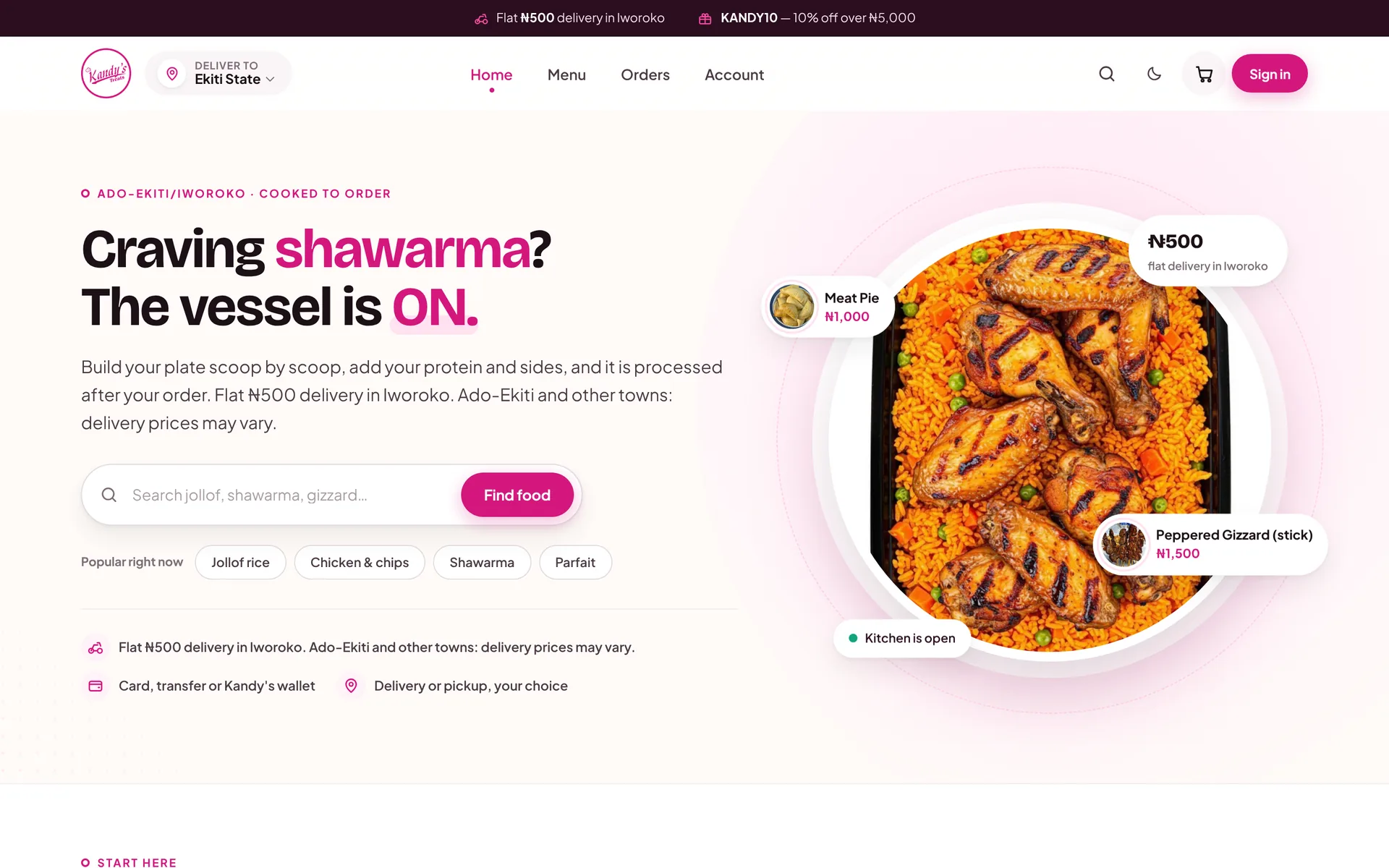
An ordering platform and operations back office for Kandy's Treats. Customers build a plate, pay by card or wallet and track the order; staff run orders, menu, inventory, finance and the team from one admin console.
- My role
- Full-stack development, payments integration, database design and migration
- Client
- Kandy's Treats, a Nigerian kitchen in Ado-Ekiti
- Category
- Web application, Commerce
01
Overview
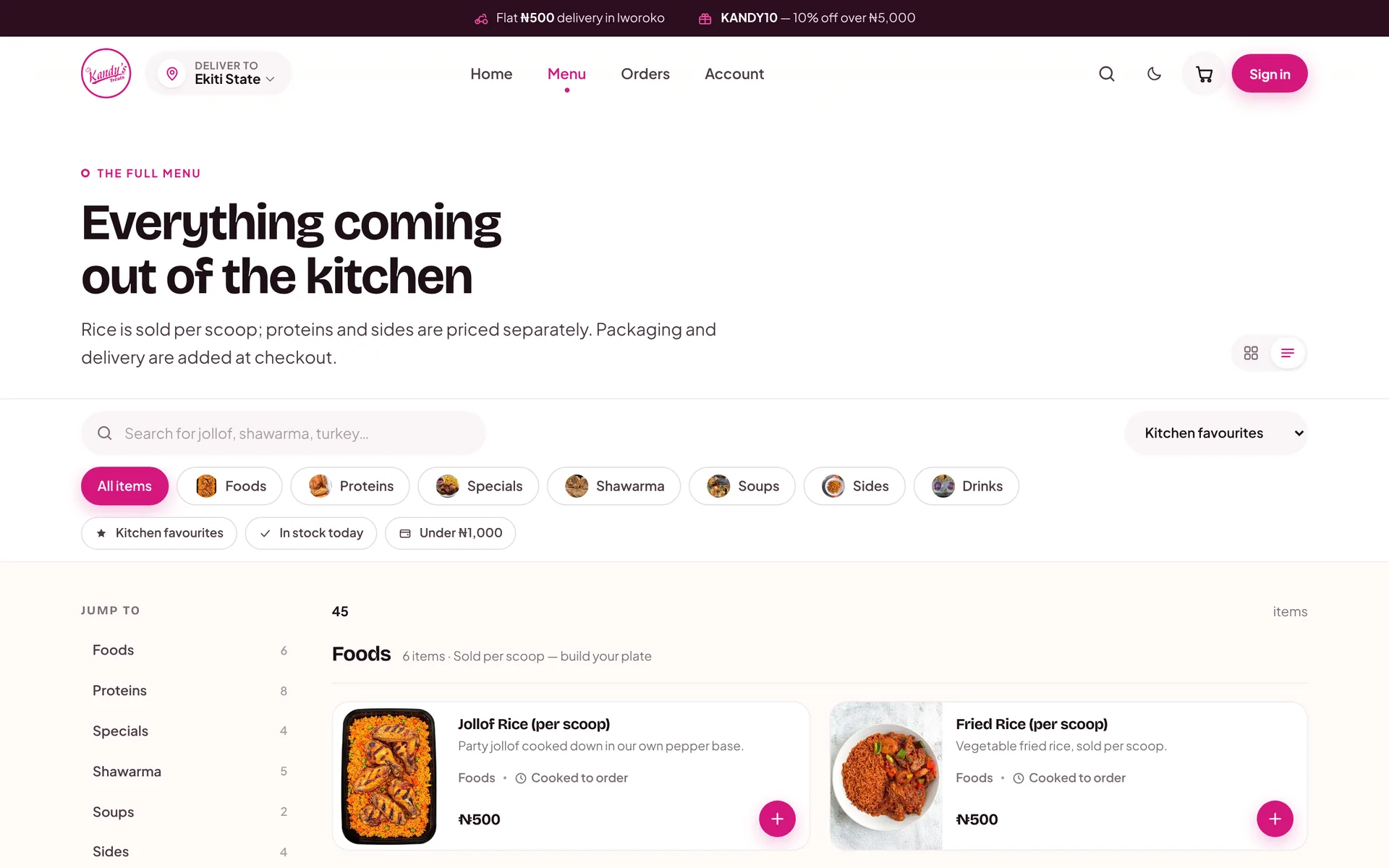
Kandy's Treats sells Nigerian food by the scoop: you build a plate from rice, proteins and sides, choose delivery or pickup, and pay. The platform covers that customer journey and the work behind it.
It started on Firebase. The current version runs on Supabase and PostgreSQL, with the storefront kept as fast, build-free HTML, CSS and JavaScript.
- HTML
- CSS
- JavaScript
- Supabase
- PostgreSQL
- Row Level Security
- Edge Functions
- Paystack
- Firebase (earlier backend)
02
The problem
Money is involved at every step: prices, packaging fees, coupons, delivery fees, wallet balances and refunds. None of those figures can be trusted if they are calculated in the browser.
The kitchen also needed more than a checkout. Staff take orders, track stock, close the day, manage the team and answer customers, and those jobs had to sit on the same data.
03
Approach
Orders are created and priced only on the server. Checkout re-reads every line from the menu, recalculates fees and coupons, and writes the order inside a database function. The browser is never granted insert or update rights on orders, wallets or payment tables.
Payments are initialised server-side and confirmed by verification plus signed webhooks, so a closed tab or a retried callback cannot double-credit a wallet.
I moved the backend from Firebase to Supabase in versioned SQL migrations, keeping old menu IDs resolvable so existing links still work.
04
Architecture
- Storefront
- Static HTML, CSS and vanilla JavaScript with no build step. Paints from a bundled menu snapshot, then refreshes from live data.
- Database
- Supabase PostgreSQL with Row Level Security and column-level grants. Over 80 versioned migrations.
- Server logic
- SECURITY DEFINER functions for checkout, wallet movements and admin actions; Supabase Edge Functions for Paystack, email and push.
- Payments
- Paystack, initialised on the server and confirmed by verification and webhooks. Card details never touch the site.
05
Key features
Build-your-plate ordering
Per-scoop pricing, proteins and sides as their own lines, packaging rules, coupons, and delivery or pickup.
Wallet
Fund, pay and receive refunds through a ledger of wallet transactions rather than an editable balance.
Order tracking
Order statuses with history and transition rules, notifications and push alerts.
Admin console
Orders, menu and catalogue, customers, support conversations, announcements, careers and settings.
Inventory and finance
An append-only inventory ledger, ingredients, end-of-day staff reports, sales reporting and a finance audit trail.
Team and partners
Staff invitations, role tiers, suspension, and partner referrals with order commission.
06
Challenges
Prices the browser cannot change
Problem
A client-calculated total can be edited before it is submitted.
What I did
The server recomputes every figure from the menu table inside the same transaction that creates the order, and the client is denied write access to the tables involved.
Migrating a live business
Problem
Moving from Firebase to Supabase risked breaking links, accounts and history the kitchen relies on.
What I did
A staged migration: schema and policies first, then features, with legacy Firebase IDs stored alongside new rows so old menu links and accounts still resolve.
Showing stale prices
Problem
A customer could see a cached price for a dish that had been repriced or sold out.
What I did
Pages render the snapshot immediately, then repaint from live data, and the basket drops lines that no longer exist before checkout.
07
Where it stands
Built
- Customer storefront, accounts, checkout, wallet and Paystack payments
- Admin console for orders, menu, inventory, finance, staff and support
- Firebase to Supabase migration of the core data and logic
The platform went to a partial launch in September 2026 and is still being refined with the kitchen.